
Life Flashes
From seeing my favourite band, to reading a long book, to not drinking, its been a month of life flashing by

Once in a Lifetime
The first Cabaret Voltaire recordings were made in the early 1970s, but punk allowed them to get signed - though alongside Wire, Joy Division, Throbbing Gristle, OMD, Soft Cell and others - they weren’t really punks. They signed with Factory, then Rough Trade, then Some Bizzare; part of an unexpected British musical avant garde that I still think is a bit underrated. Unlike most of their peers they never quite had that hit - and when house music usurped their USP, they became followers, rather than leaders for a while. Founder member Christ Watson left in 1981, and Richard H. Kirk died four years ago, after briefly resurrecting the name. The Cabaret Voltaire that unexpectedly reformed for a few shows this Autumn - first at “Sensoria,” the Sheffield electronica festival they gave a name to, and then a short run of gigs, to be followed by next year’s “final tour” in bigger venues - is Stephen Mallinder reunited with Watson, but Kirk felt there in spirit as well, for the focus, though the set went from 1978’s “The Set Up” to 1990’s “Easy Life”, was on those albums they recorded when I was at a sixth form and university - “The Crackdown” and “Micro Phonies.”
I oaw them once before, in 1990 at a festival in Heaton Park. Their peak period they weren’t often playing anywhere I could easily get to - and at that time, I didn’t know anyone who liked them. But Cabaret Voltaire have been there all my musical life, and as someone who started playing electronic music in 1984, they have been my number of direct influence. Mallinder remains a welcoming, open presence, as he has with his Wrangler project. Benge, his co-collaborator there and here, was not on stage, but had helped with recreating this new set. With a four-piece band, they adroitly moved between “eras”, not blithely recreating the songs, but repurposing them where it felt right. Like A Certain Ratio they have worked out a crowd-pleasing set, which nonetheless has plenty of deep cuts, including “Taxi Music” and selections from “Red Mecca” and “2 x 45.” In the dark, crowded confines of Gorilla, Manchester’s synth mafia were out in force, and if it erred towards men of a certain age, I’m sure their bigger gigs next year might have a broader demographic.
The sound was faultless, and the performances were great. These days its much easier to perform complex electronic music live - but they kept the essence of the originals, with a live drummer, guitar and bass, alongside the various synths and laptops. At the end of the 90 minute set you realised they could easily have swapped out most of the songs for an equally good set they didn’t play. Still, we were not unhappy to have an encore of “Nag Nag Nag” (sounding more like Hawkwind’s “Quark, Strangeness and Charm, than a punk track), and “Sensoria” to finish off.
Wonderful stuff, and for those, like me who have always loved and listened to their music, often in splendid isolation, it felt like a once in a lifetime experience - except I’ve tickets to see them next Autumn as well.
Old Mags
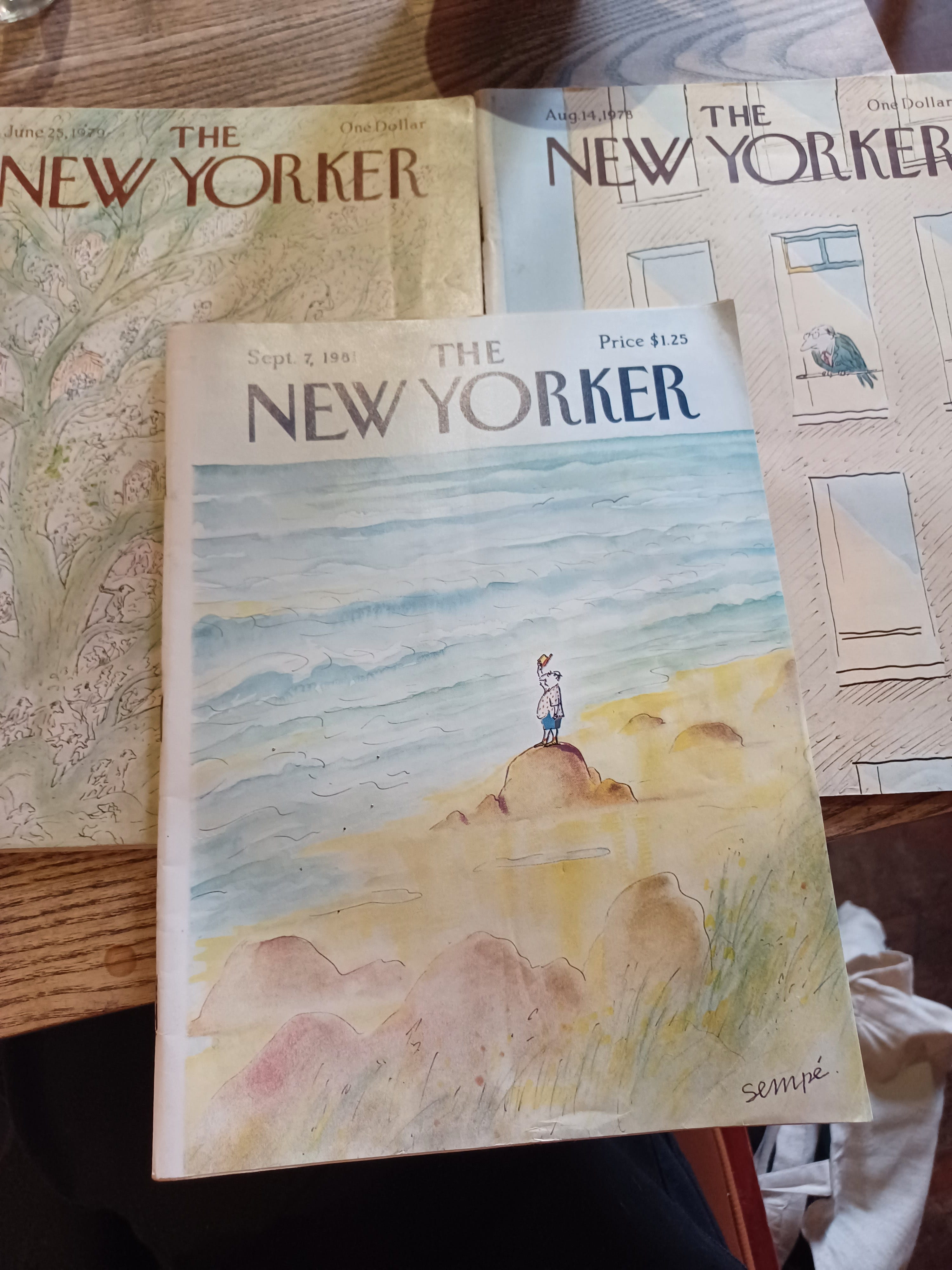
I’m sure that magazine subscriptions are God’s way of telling people they have too much disposable income. Piles of National Geographic, Prospect, Readers’ Digest, Granta, and the New Yorker pile up until the unread get moved to the charity shops. So, no, I don’t really collect the New Yorker, other than buying its summer fiction edition now and then.
I couldn’t resist looking through the large pile from 1979-81 in the Children’s Society bookshop in Heaton Moor, In pristine condition, and with gorgeous covers I picked out three. What I like is to find stories and poems in the magazines they originally appeared in, as its fascinating to see things in their original context. Two of these include stories by William Trevor, whilst a third has part 1 (of 3) of Philip Roth’s excellent novel partly about Anne Frank “The Ghost Writer.” Being the New Yorker the story’s pages are interrupted by some of the most banal cartoons ever drawn. Twas ever thus, I guess.
Every Generation Gets the Beatles it Deserves
On another platform, a few years ago, I wrote that every generation gets the Beatles it deserves. In the early 70s, those who were just too young for the band who had recently split, were treated to the carefully curated 62-66 and 67-70, which provided a soundtrack, that at the same time skewed the story (not much of “Revolver” or the White Album.) By the late ‘70s and early ‘80s and punk’s “no Beatles, no Stones, no Elvis”, we had cheap and lazy compilations, “Rock and Roll Music”, “Beatles Ballads” etc. and the “medley” craze of “Stars on 45” that led to the questionable “Beatles Movie Medley.” The murder of Lennon put to bed any last hope of a reunion. The ‘80s wasn’t kind to legacy artists - they’d have hits, but not acclaim, the technology overwhelming their charms. Ionically it was technology - in the form of the CD - that brought the Beatles back into the public eye. It was a big event when the Beatles albums got reissued on this new sonically improved format.
Skip forward to ‘90s and Britpop had made them fashionable again — old Lennon demos were resurrected, and for the first time “demos” and alternative versions were reissued, alongside a coffee table book and TV series under the “Anthology” banner. By the ‘00s, and Harrison’s death in 2001, the Beatles were now a commodity like any other. The “1” album did a poorer job of anthologising the band than the red and blue album (missing off “Please Please Me” and “Strawberry Fields Forever” for spurious reasons) and the band’s photograph didn’t even appear on the cover. It sold in the truckload. Meanwhile you could go see Cirque de Soleil’s version of their music as the “Love” show, or play a Beatles’ RockBand.
More recently, we live in an age where no copytightable stone is left unturned - and so deluxe boxsets, remasterings, and now, a 4th volume of the Anthology have all come out. Alongside the necessary - the “Get Back” Disney series, the Esher demos released in full on The White Album deluxe - there’s also the underwhelming “Let it Be”, a third "new Beatles” song “Now and Then”, and now the “Anthology” revisited. Social media, streaming, the wonderful fact that both Ringo and Paul are still touring and occasionally making records, these have helped cement the band as one of the most played, not just in history, but in the here and now; and its cross-generational. Next year we will see four Beatles movies, one for each member - in a potential fascinating, but likely to be bloated, quad-biopic, that is as much to do with the success of “A Complete Unknown”, “Elvis” and “Bohemian Rhapsody” as any artistic reason. “Backbeat” and “Nowhere Boy”, two (bitter) sweet films that have aged rather well are still out there, as are there own films, which I binged one Christmas in the late 70s. The endless Beatles books (inc. a reissued “Anthology”) keep coming. Disney, having bought up the rights to “Star Wars” and “Marvel” is basically treating “The Beatles” like another franchise. In America, twas ever thus - it was Beatles wigs, and other memorabilia, as well as the bowdlerised Capitol albums that swept across the country in the wake of JFK’s assassination.
My love for the Beatles is great, but partial - they remind me of childhood - for I listened to the red and blue albums and read the books incessantly. But by the time I was fourteen I found my own music. Lennon was dead, but so was Ian Curtis, whose music genuinely changed my life; synthpop was, to my mind, far more in keeping with the sonic experimentation of “Sgt. Pepper” than "Pipes of Peace” or the Travellin’ Wilbury’s. I listen to them reasonably frequently - but interestingly I don’t hear them played out that much. Coffee shops prefer muzak, and whatever the Beatles were at times - occasionally sentimental, sometimes twee - they were never muzak.
We get the Beatles we deserve, I feel, and with Ringo and Paul at an advanced age, it’s perhaps inevitable, that alongside their sixties peers, we want to devour as much of them as we can right now. Hard to believe that I’m old enough to have heard them on the radio back in the late 60s, though not old enough to remember it. They were and are, a rock band, even if a unique variant of the same. Obviously we will never have their like again, which is part of the fascination. For now, I’m minded to stick to the albums, and an occasional compilation (the red album, in its expanded form, is a particular favourite), and unlike, say, the Dylan Bootleg series, or Neil Young’s Archive, the Beatles’ Anthology discs are more of historical interest, than great additions to the canon. I don’t think many people would choose these variants ahead of the studio versions. We’re still waiting for “deluxe” versions of the pre-”Revolver” albums, but there’s probably less to be shared here, given the rudimentary recording set up of the early 60s; and a “cleaned up” “Live at the Star Club, Hamburg,” but that you feel is probably it.
The DVD Renaissance
Though DVDs can be had in the charity shops two-for-a-penny (or four for £1), there’s one part of the DVD market that seems to be surprisingly bouyant. Boutique labels doing collectors editions, in ever improved formats to match ever-growing screen sizes, are surprisingly catholic in what now constitutes of classic. Whether it BFI or Criterion Collection or some other label, the relatively new (David Byrne’s “American Utopia”), the translated classic (“Yi Yi”), and fondly remembered kitsch (“Pee Wee’s Big Adventure”), jostle with restored relics of old Hollywood (“His Girl Friday”) and undoubted classics (1976’s “Network.”) Presumably there is an audience for all of these - though the prices are £20-£30.
The last month though has seen the annual Criterion collection sale, and I’ve picked up four films, artist biopic “Basquiat,” Visconti’s impressionistic “Death in Venice”, Paul Schrader’s Phillip Glass-soundtracked “Mishima”, and most intriguing, Richard Pryor’s “Jo Jo Dancer, Your Life is Calling.” None of these are films I’ve seen. Looking at what else is still in the sale, this could soon become an expensive hobby.
A Good Month for Poetry
I’m not sure you could have gone out to a poetry event in Manchester every day in Manchester during November but it wouldn’t have been far off. Whether regular open mic nights like Verbose at the King’s Arms, or Speakeasy at Dulcimer; or guest poets reading such as at Jeremy Over, Sarah-Clare Conlon, David Gaffney and Frances Presley at Peter Barlow’s Cigarette, or one-offs like Jean Sprackland’s book launch, with guest poet, Canadian joint-Forward prize winner Karen Solie, who read from her eco-slanted “Wellwater”. I was quite taken by this collection, a sort of eco-elegiac nature-poetry, with that long prose-like line that seems commonplace amongst North American poets. I was also pleased to bump into Michael' Symmons Roberts as I’d just read a wonderful poem by him, “Taxonomy”, in the new Poetry London. It’s an elegy - for his mother - and it’s very moving. The whole issue, with Niall Campbell as editor, is very strong. Also out this month is issue 2 of “Aftershock Review” a new poetry magazine helmed by Max Wallis, with poetry about what comes after the trauma in our lives - if that sounds overwhelming - it provides a garden-wall rather than a restriction, so that the poems that flow from this are grouped together. With features in The Times and on Radio 4’s “Front Row”, it’s developed a remarkable presence in a short time, and it’s well worth getting hold of a copy.
The Spy’s a Liar
For various reasons, I only finished one novel this month but it was a long one, John Le Carre’s “A Perfect Spy.” It’s pretty much a spy novel in name only. 700 pages that owes a lot to his own autobiography, and particularly to the life of his father, who was not just a con man, but rotten through and through. In “A Perfect Spy”, the father has just passed away, and the son - like Le Carre was briefly - is a spy, running the Czech operation (this is one of the pre-1989 novels). The story flits between his chaotic childhood in the ebb and flow of his father’s life, sometimes wealthy (with other people’s money) more often than not on the run, leaving everything behind. Despite that the young Magnus Pym is given the classic upper-middle class childhood - public schools, then Oxford, then identified as a potential recruit for the secret service. The story is partly told through the memoir / stroke letter that the older Pym is writing in his bolthole, a sleepy seaside retreat where he goes by the name of Canterbury, that he has set aside all these year for such a moment - for Pym in the present day has bolted, and not told his superiors where he is - and neither them, or the Americans, or, as it becomes clear, his handlers on the other side, know where he has gone. The spy in other words, is just another kind of con man.
It’s the sort of book I think people had in mind when they said Le Carre should be nominated for literary prizes, and its incredible readable, if, at the same time, somewhat frustrating. Pym refers to the younger version in the 3rd person, and his reminisces are faulty, partial - as if he’s still the unwitting child, dazzled by all the women who acted as surrogate mothers round his father Rick. One, in particular, a German woman, he holds in particular esteem. Yet the story is fragmented, and similar to the spy tales for which he is famous, you never quite know which end of the thread you are holding before it unravels. The story itself turns out to be simplicity itself, but if I had misgivings, it perhaps because there’s only so many times you can read the stories of sensitive young men, unhappy at public schools, emotionally distant, and then moving through to a similar privileged environment at Oxford or Cambridge - this is probably the fourth British novel I’ve read with that trajectory in the last few years. I can barely recall a novel where someone reminisces about their state school.
The book is brimming with Dickensian brio, occasionally the sentences fall over themselves, making little sense at all (Pym the “amateur” writer), but in class Le Carre fashion everything does slot (nearly) into place, and the spy career that Pym has fashioned for himself appears to be glorious red herring. Like Rick’s con tricks, Magnus’s managing of his Czech network requires a willing mark, and the secret service is more than happy to take on that role. Despite its length, it was unputdownable on a weekend when I was unable to do much other than read.
I wondered if it had been adapted. Its great when you get into the flow of it, but quite a slow start, but v readable.
A Perfect Spy is on on my list to read. The BBC adaptation starring Peter Egan is magnificent. The scene where Pym hears 'Underneath the Arches' playing on the drinks cabinet is one of my favourite scenes in TV.